Sunday, December 20, 2009
If you think those plastic keys in hotels all goes to dump sites, think again. In Manhattan in New York, Holiday Inn made a hotel made from plastic key cards. This hotel, named Key Card Hotel, opened for business on September 19th to September 21st and was built by Bryan Berg, the world record-holding 'card-stacker'.
This 400 sq ft, two-ton construction includes a guest bedroom, bathroom and lobby, all fully equipped with life-sized furniture.
 Kevin Kowalski, senior vice president of global brand management at Holiday Inn, said: ‘The Key Card Hotel is a fun and interactive way to showcase the changes happening at our hotels and is the only structure of its kind to ever be created by a hotel brand.’
Link
Posted in:
structure,
xo feat
|
|
|
 |

Sunday, February 22, 2009
Located in Northern Russia, the Kola Superdeep Borehole is the world's deepest man-made hole to earth's ground. It measures 40,226 feet or over 7.6 miles below the earth's surface.
 Site of the Kola Superdeep Borehole
Considered to be the pride of Russian geology, the hole was created by the USSR and was the result of a scientific drilling project to drill as deep as possible to investigate the continental crust. The drilling began on May 24, 1970 on the Kola Peninsula, using an "Uralmash-4E" and later an "Uralmash-15000" drilling rig. After 24 years the drilling was stopped because it was getting too hot inside it.
The site is currently controlled by the State Scientific Enterprise on Superdeep Drilling and Complex Investigations in the Earth's Interior (GNPP Nedra) as the Deep Geolaboratory. As of 2003, the deepest active bore is SG-5, at 8,578 metres (28,143 ft) deep and 214 mm (8+7⁄16 in) in diameter.
Link (
Image Source)
Posted in:
structure,
world record
|
|
|
|
Saturday, November 1, 2008
This Thai Temple named “Wat Lan Kuad” or “Temple of Million Bottles” is literally made from more than one million recycled bottles. It is estimated that the whole structure is made from 1.5 million recycled bottles - most of them are donated.
Link
Posted in:
places,
structure
|
|
|
|
Monday, September 22, 2008

Still under construction yet the Burj Dubai is now the world's tallest building. As of September 2008, it's total height reached 688 meters or 2,257 feet and when completed, Burj Dubai will be more than 800 meters in height with 160 livable floors.
The building began construction in September 2004 and is expected to be finished on September 2009. The total budget of construction is $4.1 billion and the price of office space is $4,000 per sq foot.
(
Image source)
Posted in:
structure,
world record
|
|
|
|
Tuesday, September 16, 2008
At 2.3 hectares in total area, St. Peter's Basilica is the world's largest Christian church. It is located in the Vatican City of Rome in Italy.
The basilica is believed to be the burial site of St. Peter, one of the 12 apostles of Christ. For this reason, all the Popes have been buried there. It is also famous as a place of pilgrimage, for its liturgical functions and for its historical associations.
 St. Peter's is famous as a place of pilgrimage, for its liturgical functions and for its historical associations. It is associated with the papacy, with the Counter-reformation and with numerous artists, most significantly Michelangelo. As a work of architecture, it is regarded as the greatest building of its age. Contrary to popular misconception, Saint Peter's is not a cathedral, as it is not the seat of a bishop. It is properly termed a basilica. Like all the earliest churches in Rome, it has the entrance to the east and the apse at the west end of the building.
Link
Posted in:
structure,
world record
|
|
|
|
The Monitor-Merrimac Memorial Bridge Tunnel is truly a marvelous piece of engineering. This underwater bridge between Sweden and Denmark connects connects Suffolk, VA and Newport News, VA. The submerged portion of the bridge serves as ships canal.
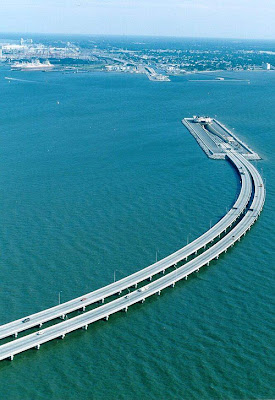 Link
. More pictures
here.
Posted in:
places,
structure
|
|
|
|
This is a video of El Camino del Rey, one of the world's dangerous walkway in southern Spain. I was made to provide walkway for the workers of the Chorro Falls and Gaitanejo Falls, who were making a dam that time, to provide transport of materials. I took four years to finish, from 1901 to 1905.
Link
Posted in:
odd videos,
places,
structure
|
|
|
|
The Millau Viaduct located in France is the world's tallest vehicular bridge with one mast's summit at 343 metres. Designed by civil engineer Michel Virlogeux, it is a large cable-stayed road-bridge that spans the valley of the River Tarn near Millau in southern France.
 Millau Viaduct is located in Millau, France, in the Département of Aveyron. Before the bridge was constructed, traffic had to descend into the Tarn River valley and pass along the route nationale N9 near the town of Millau, causing heavy congestion at the beginning and end of the July and August vacation season. The bridge now traverses the Tarn valley above its lowest point, linking the Causse du Larzac to the Causse Rouge, and is inside the perimeter of the Grands Causses regional natural park.
Link
Posted in:
structure,
world record
|
|
|
|
The Octagonal Castle, known as Castel del Monte in Puglia, Italy is famous because of it's shape.
 It was built in 1240 on the orders of emperor frederick II who used the castle as a hunting lodge. the emperor was fascinated by mathematics and astronomy, a result of which can be seen in the design.
Link
Posted in:
places,
structure
|
|
|
|
Wednesday, February 27, 2008
The Svalbard International Seed Vault, a.k.a. The "Doomsday" Vault, is an underground tunnel that will house seeds from all known varieties of food crops around the world. The vault is built to protect millions of food crops from climate change, wars and natural disasters.
 The Svalbard International Seed Vault will be built into a mountainside on a remote island near the North Pole. The vault aims to safeguard the world's agriculture from future catastrophes, such as nuclear war, asteroid strikes and climate change. Construction begins in March, and the seed bank is scheduled to open in 2008.
Link
Posted in:
structure
|
|
|
|
Thursday, February 14, 2008
Located in one of the busiest streets in Portland, Oregon, USA, Mill Ends Park is the world's smallest city park measuring only 452 square inches.
 The Guinness Book of Records granted it the title of "world's smallest park" in 1971. After Mill Ends officially became a city park on St. Patrick’s Day in 1976, the park continued to be the site of St. Patrick's Day festivities. Over the years, contributions have been made to the park, such as the small swimming pool and diving board for butterflies, many statues, a miniature Ferris wheel (which was brought in by a normal-sized crane), and the occasional flying saucer. The events held here include concerts by Clan Macleay Pipe Band, picnics, and rose plantings by the Junior Rose Festival Court.
Link
Posted in:
places,
structure,
world record
|
|
|
|
The list below is the top ten world's most expensive office space rental per square foot.
 1. London (West End), England - $328/square foot
2. Mumbai, India - $190/square foot
3. London City, England - $181/square foot
3. Moscow, Russia - $181/square foot
4. Tokyo (Inner Circle), Japan - $179/square foot
5. Tokyo (Outer Circle), Japan - $155/square foot
6. Paris, France - $127/square foot
6. New Dehli, India - $127/square foot
7. DUblin, Ireland - $114/square foot
8. Hong Kong - $106/square foot
9. Singapore City, Singapore - $102/square foot
10. Midtown Manhattan, USA - $101/square foot
Link
Posted in:
structure,
top list,
world record
|
|
|
|
Wednesday, January 9, 2008
Dr. Zahi Hawass, an Egyptian Egyptologist and archaeologist, and his team, studied the complex Great Pyramid of Khufu. Their studies lead to discovering of the plans of the great pyramid.

The Great Pyramid of Khufu has always fascinated people because it is the only ancient wonder of the world that exists today. It is also possible people are fascinated because Khufu’s pyramid, especially the interior, is very complex. The modern entrance to the pyramid was created in the Ninth Century A.D. by el-Mamoun son of Haroun el-Rhasied. The true entrance is above this one. This passage goes down through the pyramid, and then connects to another corridor that ascends to the King’s and Queen’s Chambers. The original passage continues downwards into an unfinished chamber directly under the pyramid. Discussion about the purpose of these chambers and the complexity of the pyramid is varied and ongoing.
Link
Posted in:
discovery,
structure
|
|
|
|
Sunday, December 16, 2007

According to a French architect, Ancient Egyptians built the 480-foot-high (146-meter-high) Great Pyramid of Giza from the inside out. This findings is based on eight years of study of Jean-Pierre Houdin, who has created a three-dimensional computer simulation to present his hypothesis. He says his findings solve the mystery of how the massive monument just outside Cairo was constructed.
The 4,500-year-old tomb of Pharaoh Khufu, he concluded, was built using a ramp that spirals around the pyramid's interior 30 to 45 feet (9 to 14 meters) behind the exterior surface (see image at above).
"I am completely comfortable with this theory," Houdin said in a telephone interview from Paris. He was in the French capital on Friday to show the simulation to 400 spectators wearing 3-D goggles.
Link
Posted in:
structure
|
|
|
|
Tuesday, December 11, 2007

A recently discovered underground temple, dubbed as The Temples of Damanhur, is considered the Eighth Wonder of the World by the Italian government. This temples are the work of Oberto Airaudi, a 57-year-old former insurance broker from northern Italy, with the help of like-minded volunteers from around the world. The construnction of the temples began on August of 1978 with the use of hammers and picks for digging. By 1991, several of the nine chambers were almost complete with stunning murals, mosaics, statues, secret doors and stained glass windows. The temples is named after the ancient subterranean Egyptian temple meaning City of Light.
Link
Posted in:
structure,
world record,
xo feat
|
|
|
|
Wednesday, December 5, 2007

The 105-foot-tall (38-meter-tall) "Christ the Redeemer" statue in Rio de Janeiro, Brazil, was among the "new seven wonders of the world" announced July 7 following a global poll to decide a new list of human-made marvels.
 Great Wall of China. Constructed between the fifth century B.C. and the 16th century, the Great Wall is the world's longest human-made structure, stretching some 4,000 miles (6,400 kilometers). The best known section was built around 200 B.C. by the first emperor of China, Qin Shi Huang Di.
 Colosseum in Rome, Italy — once held up to 50,000 spectators who came to watch gory games involving gladiators, wild animals, and prisoners. Construction began around A.D. 70 under Emperor Vespasian. Modern sports stadiums still resemble the Colosseum's famous design.
 Perched on the edge of the Arabian Desert, Petra was the capital of the Nabataean kingdom of King Aretas IV (9 B.C. to A.D. 40). Petra is famous for its many stone structures such as a 138-foot-tall (42-meter-tall) temple carved with classical facades into rose-colored rock. The ancient city also included tunnels, water chambers, and an amphitheater, which held 4,000 people. The desert site wasn't known to the West until Swiss explorer Johann Ludwig Burckhardt came across it in 1812.
 One of three successful candidates from Latin America, Machu Picchu is a 15th-century mountain settlement in the Amazon region of Peru. The ruined city is among the best known remnants of the Inca civilization, which flourished in the Andes region of western South America. The city is thought to have been abandoned following an outbreak of deadly smallpox, a disease introduced in the 1500s by invading Spanish forces.
 Chichén Itzá (Mexico) is possibly the most famous temple city of the Mayas, a pre-Columbian civilization that lived in present day Central America. It was the political and religious center of Maya civilization during the period from A.D. 750 to 1200. At the city's heart lies the Temple of Kukulkan (pictured)—which rises to a height of 79 feet (24 meters). Each of its four sides has 91 steps—one step for each day of the year, with the 365th day represented by the platform on the top.
 The Taj Mahal, in Agra, India, is the spectacular mausoleum built by Muslim Mughal Emperor Shah Jahan to honor the memory of his beloved late wife, Mumtaz Mahal. Construction began in 1632 and took about 15 years to complete. The opulent, domed mausoleum, which stands in formal walled gardens, is generally regarded as finest example of Mughal art and architecture. It includes four minarets, each more than 13 stories tall. Shah Jahan was deposed and put under house arrest by one of his sons soon after the Taj Mahal's completion. It's said that he spent the rest of his days gazing at the Taj Mahal from a window. Source
See also the
Old Seven Wonders of the World pictures.
Posted in:
structure,
top list,
world record
|
|
|
|

The Great Pyramid of Giza, Egypt. The Egyptian pharaoh Khufu built the Great Pyramid in about 2560 B.C. to serve as his tomb. The pyramid is the oldest structure on the original list of the seven wonders of the ancient world, which was compiled by Greek scholars about 2,200 years ago. It is also the only remaining survivor from the original list.
 The Colossus of Rhodes, Greece. In contrast to the pyramids, the colossus was the shortest lived of the seven wonders of the ancient world. Completed in 282 B.C. after taking 12 years to build, the Colossus of Rhodes was felled by an earthquake that snapped the statue off at the knees a mere 56 years later.
 The Lighthouse of Alexandra, Egypt. The lighthouse was the only ancient wonder that had a practical use, serving as a beacon for ships in the dangerous waters off the Egyptian port city of Alexandria, now called El Iskandarîya. Constructed on the small island of Pharos between 285 and 247 B.C., the building was the world's tallest for many centuries. Its estimated height was 384 feet (117 meters)—equivalent to a modern 40-story building—though some people believe it was significantly taller.
 The Statue of Zeus at Olympia, Greece. The massive gold statue of the king of the Greek gods was built in honor of the original Olympic games, which began in the ancient city of Olympia. The statue, completed by the classical sculptor Phidias around 432 B.C., sat on a jewel-encrusted wooden throne inside a temple overlooking the city. The 40-foot-tall (12-meter-tall) figure held a scepter in one hand and a small statue of the goddess of victory, Nike, in the other—both made from ivory and precious metals.
 The Hanging Gardens of Babylon, Iraq. The hanging gardens are said to have stood on the banks of the Euphrates River in modern-day Iraq, although there's some doubt as to whether they ever really existed. The Babylonian king Nebuchadnezzar II supposedly created the terraced gardens around 600 B.C. at his royal palace in the Mesopotamian desert. It is said the gardens were made to please the king's wife, who missed the lush greenery of her homeland in the Medes, in what is now northern Iran.
 The Mausoleum of Halicarnassus, Turkey. The famous tomb at Halicarnassus—now the city of Bodrum—was built between 370 and 350 B.C. for King Mausolus of Caria, a region in the southwest of modern Turkey. Legend says that the king's grieving wife Artemisia II had the tomb constructed as a memorial to their love.
 The Temple of Artemis, Turkey. The great marble temple dedicated to the Greek goddess Artemis was completed around 550 B.C. at Ephesus, near the modern-day town of Selçuk in Turkey. In addition to its 120 columns, each standing 60 feet (20 meters) high, the temple was said to have held many exquisite artworks, including bronze statues of the Amazons, a mythical race of female warriors. Source
See also the
New Seven Wonders of the World pictures.
Posted in:
structure,
top list,
world record
|
|
|
|

 |


